


Lakewood Ranch Is Not One Big Housing Market

Lakewood Ranch may look like one large housing market on Google.
In real life? Not even close.
Lakewood Ranch is made up of three main ZIP codes—34211, 34202 and 34240—dozens of communities and countless micro-markets living under one very recognizable name.
Each community offers something different. Some are gated. Some include golf or club memberships. Some focus on maintenance-free living. Others offer larger lots, newer construction, luxury homes, townhomes, villas or resort-style amenities.
That is why saying a home is “in Lakewood Ranch” does not tell you nearly enough.
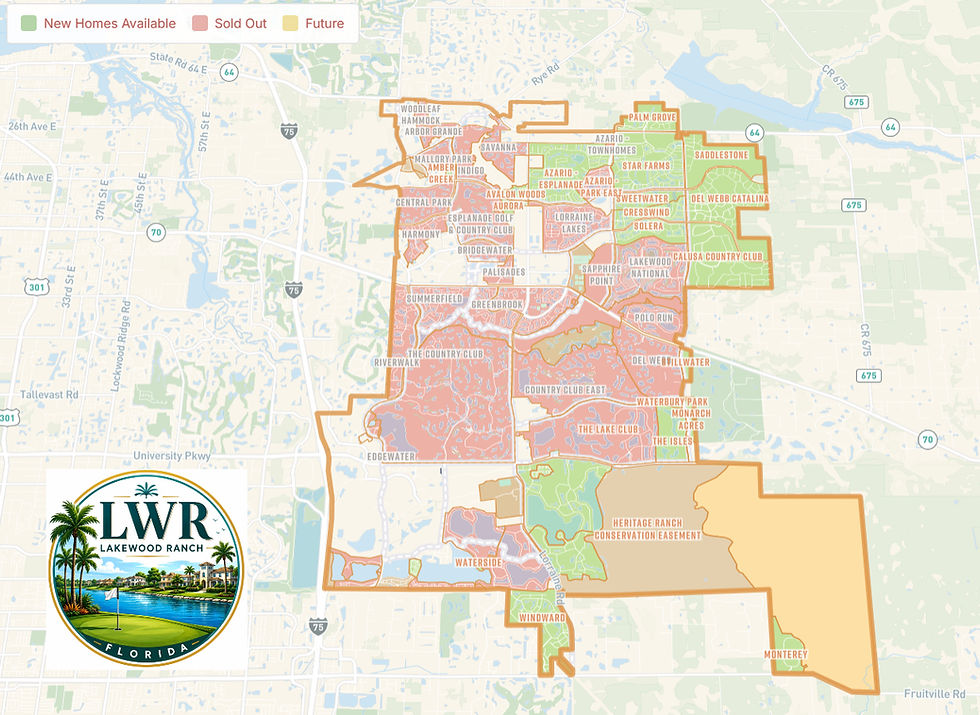
Three ZIP Codes, Multiple Markets
Lakewood Ranch stretches across parts of Manatee and Sarasota counties, and its three main ZIP codes do not behave exactly the same way.
Within each ZIP code, you will find communities with different:
Home styles and price ranges
Builders and construction ages
HOA and CDD fees
Amenities and membership requirements
Lot sizes and views
Resale inventory
New-construction competition
Buyer demand
A market update for one section of Lakewood Ranch may not accurately describe what is happening in another.
Even when overall Lakewood Ranch inventory rises, a specific neighborhood or floor plan may still have limited availability and strong demand.
Every Community Has Its Own Market
Compare communities such as Waterside, Country Club East, Esplanade at Azario, Del Webb, Lorraine Lakes and Lakewood National, and you are not comparing interchangeable neighborhoods.
Each one offers a different combination of location, housing, amenities, fees and lifestyle.
Some buyers want golf. Others do not want to pay for it.
Some buyers want a gated community with extensive amenities. Others prefer fewer fees and more flexibility.
Some want new construction. Others prefer an established neighborhood with mature landscaping and fewer years of nearby building activity.
Those differences influence which buyers are interested in each community—and what they are willing to pay.

Micro-Markets Exist Inside the Same Neighborhood
The market can change even within one community.
Two homes may share the same builder and floor plan but sell for very different prices because of factors such as:
Water, preserve or golf-course views
Road noise or nearby construction
Lot size and orientation
Privacy
Interior selections and structural upgrades
Pool and outdoor living features
Age and condition
Membership requirements
Seller motivation
Builder incentives
Timing
A home positioned on a premium waterfront lot cannot always be compared directly with the same floor plan on an interior lot.
Likewise, a highly upgraded resale may compete differently from a nearby new-construction home offering financing incentives or closing-cost assistance.
The homes may look similar on paper. Their markets can still be completely different.
New Construction Changes the Resale Market
Lakewood Ranch continues to grow, which means resale homes frequently compete with builders.
That competition can affect pricing, negotiation and how long a home takes to sell.
Builders may offer:
Mortgage-rate incentives
Closing-cost assistance
Design upgrades
Price reductions
Quick-move-in opportunities
A resale seller may have a finished pool, established landscaping, window treatments and completed upgrades that a new home does not include. However, those benefits must be presented clearly when buyers are comparing the resale with a builder’s advertised price.
To price a resale correctly, you need to understand both recent neighborhood sales and what nearby builders are offering right now.

Online Estimates Miss the Details
Automated home valuations are convenient, but they cannot fully understand Lakewood Ranch’s micro-markets.
An algorithm may see two homes with similar square footage and the same ZIP code. It may not properly account for the difference between:
Waterfront and interior lots
Golf and non-golf communities
Mandatory and optional memberships
Different CDD and HOA structures
Gated and non-gated neighborhoods
Builder incentives and resale competition
Premium outdoor living spaces
Community-specific buyer demand
That is why pricing a Lakewood Ranch home by simply plugging the address into a website can create a very misleading number.
What This Means for Sellers
Your competition is not every home listed in Lakewood Ranch.
Your real competition consists of the homes a buyer would realistically compare with yours based on community, property type, price, lifestyle and features.
Pricing too high because a home across Lakewood Ranch sold for more can cause your property to sit.
Pricing too low because an automated estimate missed your lot, view or upgrades can leave money on the table.
A strong pricing strategy should consider:
Recent sales inside the community
Current competing listings
Pending homes
Withdrawn and expired listings
Builder inventory and incentives
Lot and location differences
Upgrades buyers will actually value
Current demand within that specific market
Lakewood Ranch sellers do not need a generic market analysis. They need one built around the exact pocket of the market their home occupies.
What This Means for Buyers
Buyers should not choose a home based on the floor plan and price alone.
The same budget can create completely different ownership experiences depending on the community.
Before buying, look beyond the listing photos and consider:
HOA and CDD fees
Club or membership expenses
Amenities you will actually use
Resale competition
Builder activity
Lot quality and privacy
Insurance and maintenance costs
Future development nearby
The home’s potential appeal when it is time to sell
The goal is not simply to find a beautiful home. It is to understand what you are buying, what you are paying for and how that property fits into its specific market.
Local Knowledge Changes the Strategy
Lakewood Ranch makes sense on a map.
Understanding its housing market requires a much closer look.
It takes knowing why one street performs differently from another, which builder incentives are affecting resale values and why two nearly identical homes can sell for very different prices.
That is why I never value a home using the words “Lakewood Ranch” alone. And I do not tour homes with buyers without explaining what is happening inside that specific community and price point.
Finding homes online is easy.
Understanding which home is worth the price—and which one is not—is where real local knowledge matters.
If you are considering buying or selling in Lakewood Ranch, let’s look beyond the city name and build a strategy around the market that actually matters: yours.


Comments